
Why Cosmetic Chemists Don't Use Kitchen Ingredients in Commercial Skincare
Walk into any artisan market or browse social media, and you'll quickly come across recipes for "all-natural" skincare made with fresh oat milk, homemade herbal infusions, aloe vera straight from the plant, or botanical extracts prepared in the kitchen.

As a cosmetic chemist, I often hear questions like:
"Can we use fresh almond milk in my moisturiser?"
"I bought this medicinal root online, boiled it, and made an extract. Can we use that in my skincare range?"
"Can we just blend fresh aloe vera into the cream?"
The intention is understandable. Consumers associate fresh, homemade ingredients with naturalness and purity. However, when you're developing a cosmetic product for commercial sale, these ingredients create significant scientific, manufacturing, and regulatory challenges.
The reality is that natural and commercially suitable are not always the same thing.
Cosmetics Are Manufactured Under GMP
Cosmetics manufactured in the EU, UK and many other markets are expected to comply with Good Manufacturing Practice (GMP).
GMP is built around one principle:
Every batch should be identical in quality, safety and performance.
That means every raw material should be:
Cosmetic grade
Manufactured under controlled conditions
Fully traceable
Supplied with technical documentation
Consistent from batch to batch
Suitable for long-term storage
Compatible with commercial manufacturing
Kitchen ingredients simply aren't designed to meet these requirements.
Food Grade Does Not Mean Cosmetic Grade
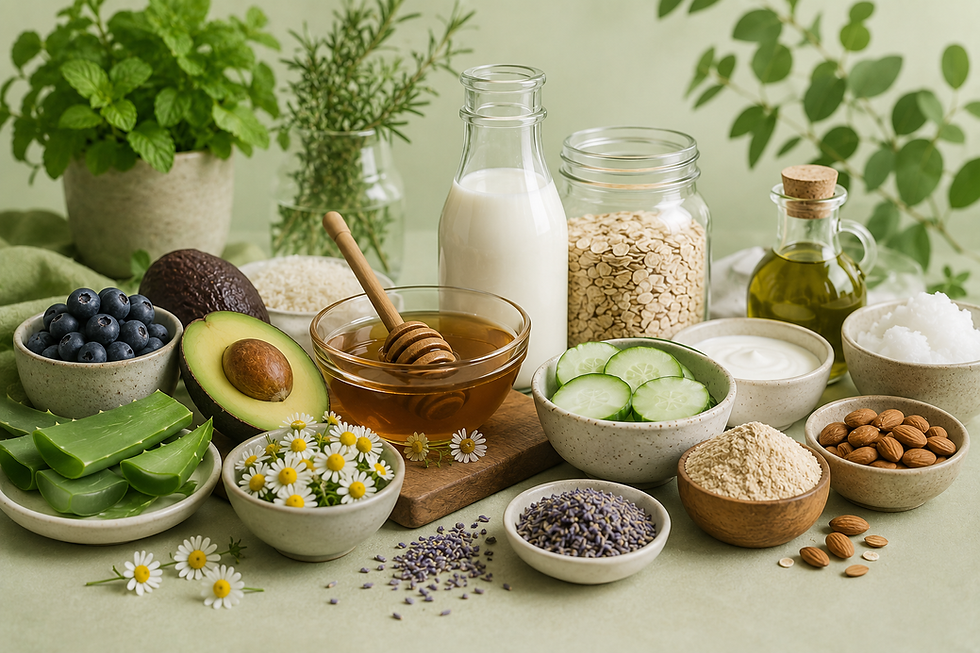
One of the biggest misconceptions is that food-grade ingredients are somehow "better."
They're not.
They're simply designed for a different purpose.
Food ingredients are manufactured to be safe to eat. Cosmetic ingredients are manufactured to be safe and stable in a topical product for years.These are completely different objectives. For example, fresh oat milk purchased from a supermarket is intended to be refrigerated and consumed within days after opening.
A face cream may sit
in a warehouse
in a retailer
in a customer's bathroom
for 30 months or more. These are very different environments.
Microbiology Requirements Are Different
Fresh foods naturally contain microorganisms. Fresh herbs, vegetables, fruits, and grains all carry bacteria, yeasts, and moulds from the soil, harvesting, and processing. That is perfectly normal.
Food safety regulations focus primarily on ensuring dangerous pathogens are absent while accepting that many harmless microorganisms will naturally be present.
Cosmetics have a different challenge.
Once a cream, serum, or cleanser is opened, consumers repeatedly introduce new microorganisms by touching the product or exposing it to water and air. The preservative system must keep that product safe throughout its entire shelf life. For this reason, cosmetics are expected to have very low microbial counts and comply with ISO 17516:2014 microbiological quality requirements.
For most cosmetics:
Total aerobic microorganisms: ≤1,000 CFU/g
Yeasts and moulds: ≤10 CFU/g
Products intended for babies, the eye area, or mucous membranes have even stricter limits for total aerobic microorganisms ≤100 CFU/g.
In addition, certain microorganisms must be completely absent, including:
Staphylococcus aureus
Pseudomonas aeruginosa
Escherichia coli
Candida albicans
Fresh homemade botanical extracts simply aren't produced to these microbiological standards.
Fresh Ingredients Are Never the Same Twice

Imagine making oat milk today.
Now make it again next month.
Even if you follow exactly the same recipe, the result won't be identical.
The oats came from a different harvest.
The water chemistry may differ.
The extraction temperature changed slightly.
The soaking time varied.
The microbiology is different.
Commercial cosmetics require reproducibility. Consumers expect bottle number one and bottle number ten thousand to perform exactly the same. Fresh ingredients simply don't offer that consistency.
Active Ingredients Can Vary Dramatically
A homemade chamomile infusion might smell wonderful.
But how much bisabolol does it contain?
How much apigenin?
How much of the anti-inflammatory compounds actually made it into your extract?
Nobody knows.
Professional cosmetic extracts are often standardised. That means manufacturers measure specific active compounds and ensure every batch delivers consistent performance. This consistency allows formulators to develop reliable products and support efficacy claims.
Preservatives Are Not Magic

Many people assume adding a preservative solves everything.
It doesn't.
Fresh ingredients contain:
proteins
sugars
enzymes
minerals
natural microorganisms
These components can interfere with preservative systems, increase microbial growth, or reduce product stability. Preservatives are designed to protect properly formulated cosmetic products—not to rescue contaminated raw materials.
Heavy Metals and Natural Impurities
Plants naturally absorb substances from the soil. Depending on where they were grown, they may contain varying levels of:
Lead
Arsenic
Cadmium
Mercury
Professional cosmetic ingredient manufacturers routinely monitor and control these impurities.
When someone prepares an extract at home, there is no testing to determine whether heavy metals, pesticide residues, or other contaminants are present. The same applies to allergens and unwanted plant compounds. Without analytical testing, you simply don't know what's in the final extract.
There Is No Technical Documentation
Commercial cosmetic development depends on documentation. Every raw material should ideally come with documents such as:
Certificate of Analysis (CoA)
Safety Data Sheet (SDS)
Technical Data Sheet (TDS)
Microbiological specification
Allergen information
Regulatory declarations
INCI name
Manufacturing information
A homemade botanical extract has none of these. Without documentation, it's impossible to complete a proper safety assessment or support regulatory compliance.
Homemade Doesn't Scale

This is one of the biggest challenges for startup brands. You might successfully make 500 ml of botanical extract in your kitchen.
Can you make:
50 kg?
500 kg?
5 tonnes?
Will every batch contain the same concentration of active compounds?
Will every batch have identical microbiological quality?
Can another manufacturer reproduce your process exactly?
Commercial manufacturing demands processes that are validated, repeatable, and scalable.
Kitchen methods rarely are.
Cosmetic-Grade Botanical Extracts Solve These Problems
Fortunately, there is a better solution. Many plants are available as professionally manufactured cosmetic-grade extracts.
These ingredients are:
Standardised
Microbiologically tested
Quality controlled
Traceable
Manufactured under GMP
Supported with technical documentation
Compatible with cosmetic preservatives
Suitable for commercial production
They allow formulators to capture the benefits of botanicals while producing products that are safe, compliant, and consistent.
Nature and Science Work Together
Choosing cosmetic-grade ingredients doesn't make a product less natural.
It makes it more reliable.
The goal of cosmetic formulation isn't simply to create something that works once in the kitchen.
It's to develop a product that can be manufactured repeatedly, remain safe throughout its shelf life, comply with regulations, and deliver the same performance to every customer.
That's where cosmetic chemistry adds value. Good formulation isn't about putting food into a bottle.
It's about combining the best of nature with science, GMP, and quality control to create skincare products that consumers can trust.
About Me

I'm Justyna Szpak, an independent cosmetic formulation chemist with over 20 years of experience in cosmetic R&D. From my fully equipped laboratory in Ireland, I help brands develop innovative, safe and compliant cosmetic products—from the initial concept through formulation, testing, regulatory compliance, and manufacturing support.
Whether you're creating your first product or expanding an existing range, I'd be delighted to help you bring your idea to life.
Let's create beauty together.


Comments